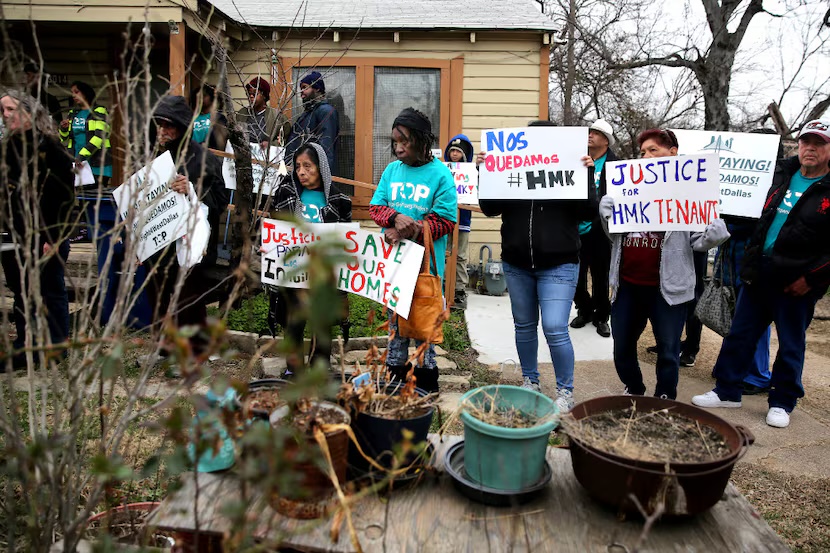
The Syracuse Common Council deadlocked 4-4 on Good Cause Eviction on February 23, 2026. The measure failed. Landlords and realtors who had spent weeks warning the council that the law would damage the city’s rental market walked out with the outcome they wanted.
The result surprised people. Mayor Sharon Owens supported it. At least five council members had publicly backed it heading into the vote. The night before, advocates still believed they had the votes. Then two members reversed course, the deadlock held, and a law designed to give tenants more stability in the nation’s fastest-rising rental market never got off the ground.
The arguments that worked are worth examining closely. Not because the fight is over — it is not — but because they reflect real concerns about what rent restrictions do to housing markets over time. And because the data from other cities that tried this is more complicated than either side in the Syracuse debate acknowledged.
How the votes flipped
Marty Nave reversed his earlier support after receiving an email the morning of the vote. A renter constituent was worried the law would prevent landlords from removing bad tenants and would drive up rents. Donna Moore said she changed her mind multiple times before settling on no. She had fielded more than 125 constituent contacts, 85 percent of them opposed. Patrona Jones-Rowser cited eviction data showing “only slight decreases — not the 40%, 50%, 60% decrease that Good Cause Eviction enthusiasts claimed.” Rasheada Caldwell said the legislation created an adversarial environment and called for a commission of landlords and tenants to study alternatives first.
With one council seat vacant and Council President Rita Paniagua barred by the city charter from casting a tiebreaker vote on local laws, the measure died without passage.
What landlords actually argued
The landlord side made explicit threats and substantive arguments. The threats got the attention. The arguments deserve scrutiny on their own.
Jonathan Geller, who owns 99 units in the city, told the council: “At the end of the day, sometimes you have to sit back and take a look and see if my equity is better served with it being invested somewhere in another area.” He noted that out of 81 units at his Polk Street properties, he had 41 tenant turnovers last year. The margins were already precarious. Pat Goodyear put the rent-cap-as-floor concern in direct terms: “When I tell Natasha and Fred that their rent is going from $950 to $1,600 so I don’t lose equity in my two-families… that comes back on all of you.” Tom Riddel, president of the CNY Landlords Association, said the same thing differently: “I will have to adjust all of my tenants’ rents, which penalizes the good tenants.”
All three were describing the same dynamic: when a landlord knows their future ability to adjust rent is capped, they raise rent to the cap immediately — regardless of current market conditions — to protect themselves from being unable to cover future cost increases. A law designed to stabilize rents can produce the opposite effect in the short term.
City Auditor Alex Marion pushed back, saying landlords “will continue to find ways to successfully operate their businesses” and calling the threats a bluff. That rebuttal did not hold the two wavering votes.
The problem tenants who pay rent
The clearest argument against Good Cause — and the one that appears to have resonated most directly with Nave’s constituent — is what happens to tenants who pay rent on time but make the building unlivable for everyone else.
Under Good Cause, removing such a tenant requires proving “nuisance” in housing court. That means documented, repeated violations, usually police reports and code enforcement records. Most problem tenants stay just below the legal threshold. The other tenants leave. Good tenants always leave first. Now you have vacancies, a deteriorating building, and a problem tenant who is protected by law as long as the rent check clears.
The law’s sponsors would say this is what courts are for. That is technically true. It is also true that small landlords in Syracuse do not have legal departments, and that a court battle over nuisance is expensive and slow for someone operating a six-unit building at thin margins.
Rent caps and what they do to buildings
The rent cap provision — the lesser of 10 percent or CPI plus 5 percent annually — is where the most documented long-run damage tends to occur. When revenue is constrained and expenses are not, the gap closes through deferred maintenance.
Property taxes in Syracuse have risen 15 to 20 percent over the past three years. Insurance premiums have roughly doubled for many landlords since 2022. A new roof costs twice what it cost in 2019. When your expenses rise 15 percent and your revenue is capped at 8.79 percent, the gap comes out of maintenance. The building deteriorates. The tenants live in worse conditions. This is not theory.
New York City’s rent-stabilized housing stock is the oldest evidence in the state. Pre-1974 stabilized units now average 75 to 79 percent more maintenance deficiencies than market-rate apartments. Since 2022, 176 stabilized buildings have entered foreclosure, with annual foreclosures roughly doubling each year and more than 2,000 additional properties in mortgage-default warning status. In the 1970s through the early 1990s, a combination of rent ceilings and rising costs caused landlords to abandon buildings at scale. More than 200,000 rental units were lost. In parts of the Bronx, more than 80 percent of the housing stock was destroyed.
Binghamton’s mayor, Jared Kraham, vetoed that city’s Good Cause bill last spring with exactly this warning: “Bringing NYC-style housing regulations to Binghamton will backfire, pushing out good landlords who are providing quality housing to families, discouraging investment in rental properties and hurting the very people this legislation intends to help.” The council overrode him 7-0. Results are still accumulating.
Investors are already leaving New York
The capital flight argument is not hypothetical. Danny Fishman, a principal at Gaia Real Estate, redirected $200 million in investment away from New York to Florida, Nashville, Texas, and Las Vegas after the 2024 Good Cause law took effect. “Generally, we see the city as too much of a risk, and good cause eviction, together with other regulatory risks, was one of the main reasons,” he told The Real Deal. “Even for a free-market unit it’s very hard to evict someone… most people doing business in the city are fed up.”
Rochester’s landlords are “already selling to out-of-town buyers,” according to analysis in City Journal, “shifting ownership away from local operators, who have a stake in neighborhood stability.” Rochester adopted Good Cause in December.
For Syracuse, where the property tax burden is already among the highest in the state and where the climate is rough on buildings, the regulatory risk calculation matters. Out-of-state investors ask about the regulatory environment before they ask about cap rates. A city that had narrowly avoided Good Cause one year and was one council appointment away from passing it the next is not a city that inspires long-term investment confidence.
The supply problem that housing advocates do not acknowledge
The most contentious argument is also the most important one. When you cap rents and restrict evictions, housing supply shrinks. Landlords convert rental units to owner-occupied or let buildings sit vacant. New construction slows because the return no longer justifies the risk. Less supply with stable or rising demand means higher rents for everyone who needs to move.
A 2019 Stanford study of San Francisco’s rent control expansion, published in the American Economic Review, found that landlords reduced rental housing supply by 15 percent — primarily by selling to owner-occupants or redeveloping. The citywide effect was a 5.1 percent increase in rents across all units, including those not covered by rent control, as supply tightened for everyone.
The NYU Furman Center’s 2024 analysis of New York’s Good Cause law acknowledged the law’s intentions but warned it “could potentially discourage investment in housing, raise costs for all tenants, and make it even harder for tenants to find a suitable home.” Specifically: small landlords who historically used relationship-based screening — giving breaks to applicants who might not pass strict income or credit checks — would shift to “the intensive screening of prospective tenants now used by almost all large landlords.” Good Cause would make it harder for the lowest-income renters to find housing while protecting renters who already have it.
Supporters dispute this. A University of Minnesota study of Good Cause laws in California, Oregon, and New Hampshire found that housing construction permits did not decline relative to neighboring states. The academic debate is not settled. What is clear is that the supply argument cannot be dismissed — and Councilor Jones-Rowser was not wrong that the claimed eviction reduction benefits in opted-in cities were modest, not transformative.
The numbers that made the case for it
Acknowledging all of this does not mean the status quo was working. It was not.
Syracuse was ranked the most competitive rental market in the United States. One-bedroom rents rose 22 percent in a single year. The vacancy rate in Q4 2023 was 1.8 percent, one of the tightest in the country. The city filed approximately 2,951 evictions in 2024 — 160 per month. Judges sided with landlords in 64 percent of all cases. In holdover proceedings, landlords won 95 percent. Homelessness in Syracuse has increased 63 percent since 2019. Family homelessness is up 192 percent.
Of the eviction cases filed for nonpayment of rent, only 6 percent of surveyed renters said they were actually behind on rent. That gap — between how often the nonpayment legal mechanism is used and how often tenants genuinely cannot pay — is what tenant advocates were pointing to when they argued the law had real work to do.
Sally Santangelo of CNY Fair Housing said after the vote: “For tenants, it really can’t get much worse.” She pointed to the Nob Hill Apartments case, where tenants who had submitted maintenance requests were now facing lease non-renewals with no legal protection. That kind of retaliatory non-renewal is exactly what Good Cause was written to stop. It exists. It is happening in Syracuse. The vote did not make it stop.
Where things actually stand
Councilor Moore said she would not support Good Cause in any future vote. That makes the vacant council seat the most direct path forward for advocates — whoever fills it will face this question explicitly. One appointment away from a different result.
In the meantime, one provision of the statewide law already applies to Onondaga County landlords whether the city has opted in or not. Since August 18, 2024, every 14-day rent demand served anywhere in New York must include a statutory Good Cause Eviction disclosure. Missing it is a ground for case dismissal in housing court. This is the newest and least-known pitfall in local eviction proceedings, and it has already produced dismissals in courts across the state.
The statewide law is not going away. The arguments on both sides are backed by real evidence, not just rhetoric. What happened on February 23 was a delay — bought, in part, by landlords making credible enough threats that two council members who supported the law’s goals decided the risks were not worth it. Whether that judgment holds depends on what the cities that opted in look like in three years.
Looking for Property Management in Central New York?
RenPro manages residential properties across the Syracuse metro area and beyond.